Generating Datasets
QDFlow is capable of generating large, diverse datasets. To do this, we need to
generate many sets of randomized physics parameters. This is accomplished
through the PhysicsRandomization dataclass, which defines distributions from
which each physics parameter is drawn.
from qdflow import generate
import tutorial_helper
from qdflow.util import distribution
import numpy as np
import matplotlib.pyplot as plt
# Create a randomization object with default distributions for each parameter
phys_rand = generate.PhysicsRandomization.default()

# Print out some of the default distributions
print("Screening Length: %s" % str(phys_rand.screening_length))
print("Gate Radius: %s" % str(phys_rand.rho))
Screening Length: distribution.LogUniform(75, 150)
Gate Radius: distribution.Uniform(10, 20)
Variable ranges can be adjusted by setting a parameter to a new distribution, or to a specific value if no randomization is desired.
# Change the distribution from which the screening length is drawn
phys_rand.screening_length = distribution.Normal(100, 20)

# Set the gate radius to a constant (will not be randomized)
phys_rand.rho = 15
Now randomized sets of physics parameters can be drawn as desired from these distributions.
generate.set_rng_seed(1) # Rng seed set for reproducibility

n_devices = 6 # How many randomized parameter sets to generate

# Generate a list of randomized sets of physics parameters
phys_params = generate.random_physics(phys_rand, n_devices)
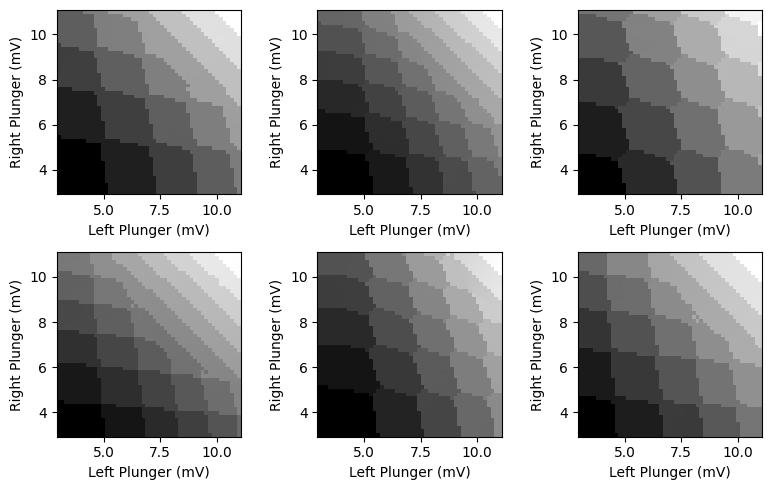
Then, all that is required is to run the simulation with each of the physics parameter sets.
# Smaller ranges and resolution used for the sake of time
V_x = np.linspace(3., 11., 50)
V_y = np.linspace(3., 11., 50)

# Run the simulation, this may take ~ 40 seconds
csds = [generate.calc_2d_csd(phys, V_x, V_y) for phys in phys_params]
# Plot the results
fig, ax = plt.subplots(2, 3, figsize=(8,5))
ax = ax.flatten()
for i in range(6):
    tutorial_helper.plot_csd_data(fig, ax[i], csds[i].sensor[:,:,0], x_y_vals=(csds[i].V_x, csds[i].V_y))
fig.tight_layout()